


Located between downtown and the modern Parque das Nações district, the parish of Marvila is bordered by a railway line and the River Tagus.
Winning team: OFFscale
Team members: Enrico Losardo, Ludovica Dangelo, Giulia Farace, Federico Ianiri, Chiara Mastellari, Chiara Filicetti, Gaia Garofali | Sapienza University of Rome
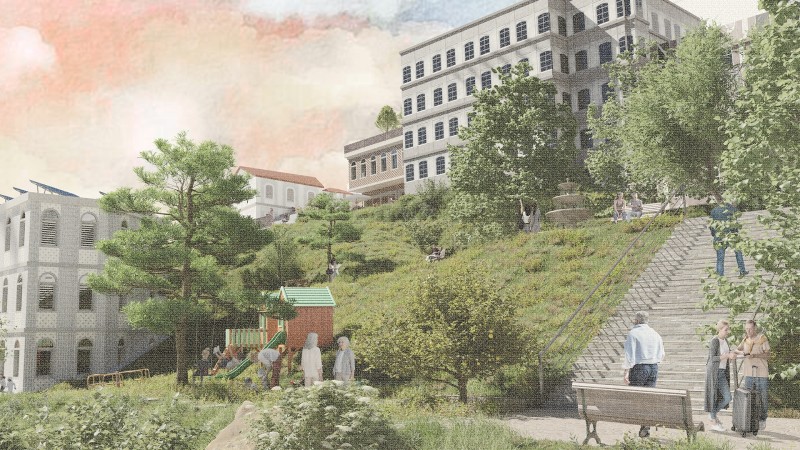
OFFSCALE took part in the competition to test new ideas and strengthen collaboration across disciplines, working together despite geographical and cultural distance. Their proposal for Lisbon focuses on reconnecting the city with water as a key element of urban regeneration, while also promoting cultural heritage through renewed community spaces. By integrating environmental and cultural priorities, the project offers a balanced and practical approach to neighbourhood transformation. The team noted that this experience confirmed the value of multidisciplinary collaboration, fostering both immediate urban solutions and lasting professional partnerships.

“This experience confirmed the value of our multidisciplinary collaboration and gave us a strong starting point for future work together”
Congratulations to all teams that participated! Check out the documentation tab to view the winning team's proposal.
Special mention, Second Place | Bairro Vivo, University of Lisbon
Team members: Kanika Singhal, Jèssica Raphaela de Carvalho Sousa, Kamran Farshchi, Zahra Shahsavand, Spencer Moore
Advisor: Carla Paoliello, Professor Faculty of Belas Artes, University of Lisbon
Special mention, Third Place | Laboratório, University of Lisbon
Team members: Diogo Santos, Francisco Castro, Tiago Rocha, Manuel Lourenço
Presentation of the site
The neighbourhood of Marvila is home to ancient aristocratic villas, monasteries, factories, warehouses and a 13 million-year-old geological monument. Despite overlooking one of the clearest stretches of the river and being home to historical industrial architecture, the area has been neglected over the years, with many buildings requiring renovation. Over the last decade, efforts have been made to regenerate Marvila. The neighbourhood now attracts several creative industries, like the Beato Creative Hub, 8 Marvila, cultural spaces like Fábrica de Braço and leisure green spaces like the Oriente Riverside Park.
Future investments are planned in the area, such as the construction of the third River Tagus crossing, the expansion of the railway line, and new housing outlined in the Matinha Urban Plan. The cultural route Caminho do Oriente, which stretches from Beato to Braço de Prata, is also undergoing a gentrification process.
Through this competition, students are invited to propose an urban regeneration for Marvila/Beato Riverside along a 2 km street called Caminho do Oriente, considering inclusivity and water management strategies. Due to its characteristics, the site lends itself to hosting various functions, such as new residential uses, offices, local commerce, creative industries, tourist facilities and leisure and recreational spaces.
Approx. site area:
109ha is the total area of Marvila/Beato Riverside. Students are invited to focus specifically on the 2 km street, Caminho do Oriente.
Key Information:
The Marvila/Beato riverside area has 3088 inhabitants per km2 (2021 census). Its population density is 57% of the average density of the city.
Priority areas & main expectations:
Teams should expand on regeneration efforts in Beato-Marvila by focusing on specific nodes along the cultural route, Caminho do Oriente, and Poço do Bispo dock. Students should seek to create green and thriving neighbourhoods, improve conditions for the Beato-Marvila population, and foster community amongst newcomers, homeless people, and entrepreneurs.



Download specific documents for this site
Keep me posted!
Questions?
If you have a question or would like more details on the site and the Students Reinventing Cities competition, please use the form below. You will receive a response via email.
