

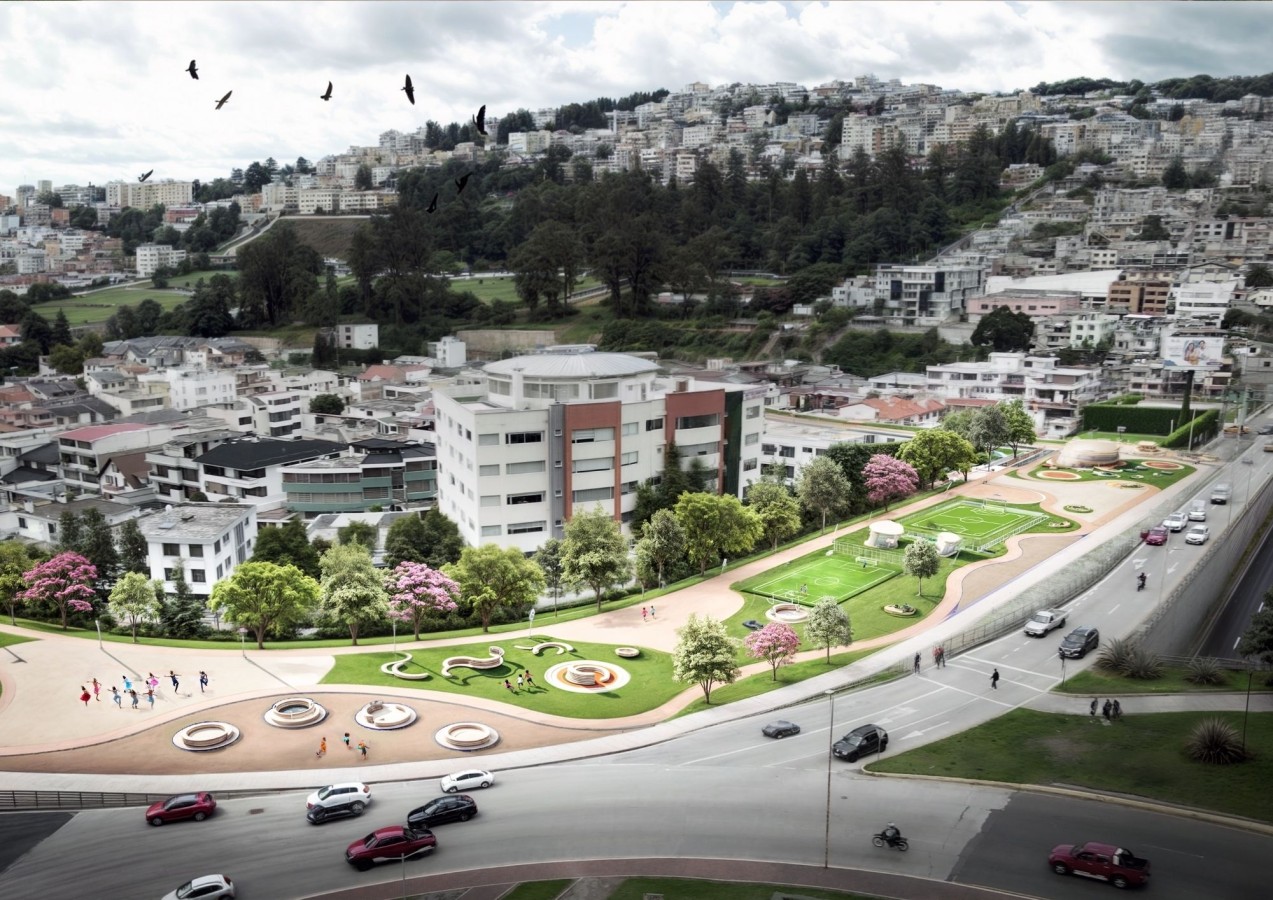
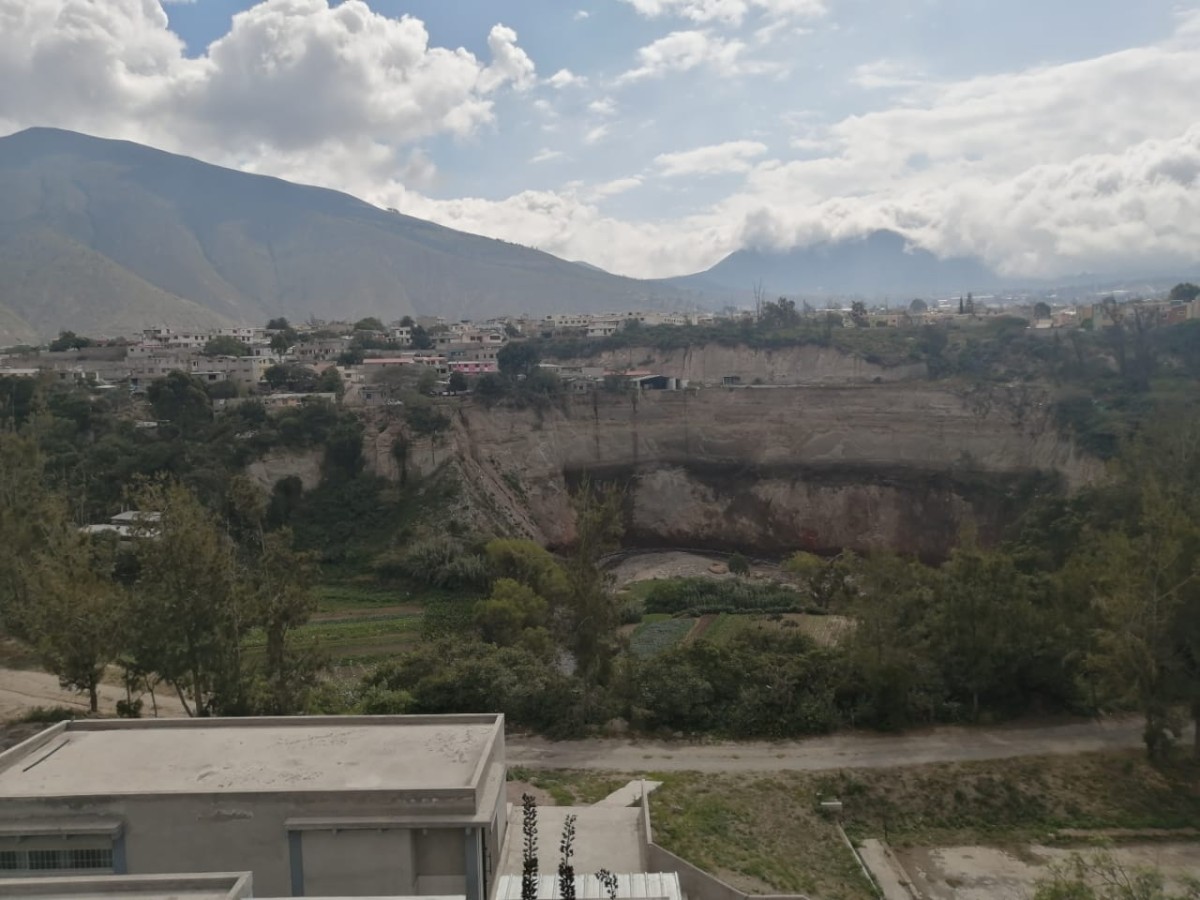
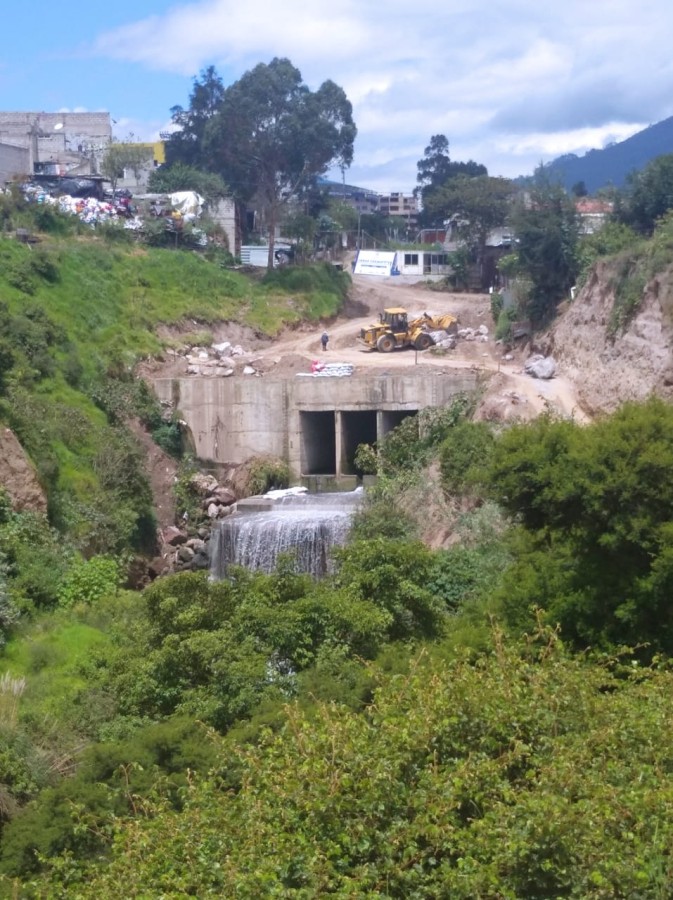
La Esperanza and El Señor del Árbol neighbourhoods are located in the lower basin of the Monjas River in the north of Quito, Ecuador's capital.
Winning team: BIO URBANIC
Team members: Andrea Raos, Mishell Villalba, Miguel Cuaspa, Doménica Albornoz, Doménica Barrera, Josué Solórzano, Melissa Ulcuango | Politecnico di Milano
Advisor: Carlos Arcos | doT+ Architects and Politecnico di Milano
The BIO URBANIC team entered the competition to envision a city where people want to live, guided by principles of sustainable resource management and inclusive design. Their project focuses on relocating residents from high-risk areas, providing dignified social housing, and fostering community integration through urban gardens and recycling initiatives.
By transforming barriers into green corridors and multifunctional public spaces, the design encourages resident engagement and long-term stewardship. The proposal demonstrates how participatory, bottom-up approaches can deliver practical, scalable solutions that respond to real urban needs, combining creativity with technical feasibility. BIO URBANIC’s project illustrates the potential for youth-led ideas to contribute to more resilient, inclusive, and environmentally sustainable neighbourhoods.

"Architecture should always be a tool to improve life and provide dignified living conditions."
Congratulations to all teams that participated! Check out the documentation tab to view the winning team's proposal.
Special mention, Second Place | EJA H¡BITAT, Politecnica Salesiana University
Team members: Esteban Piaun, Karolina Quezada, Josseph Molina, Doris Sandoval, Alex Arevalo, Lizeth Y·nez, Dayana Zoria
Advisor: Verónica Guerrero Prado, Arquitecta, Máster en Vivienda Social y Colaborativa, Politecnica Salesiana University
Special mention, Third Place | ARQT593, International University of Ecuador (UIDE)
Team members: Emilio Gonzaga, Laura Valentina López Ramos, Melanie Chicaiza
Advisor: Angel Celio Torres Biasgos, Bachelor of Science, Major Geography and Environmental Studies, International University of Ecuador (UIDE)
Special mention, Fourth Place | Cauce-Común, University College London
Team members: MarÌa Gabriela Castaneda, Mario Andre de los Santos, Jack Anthony McWaters, Agostina Argiru Fuertes, Christopher Alan Rosselot, Andrès Felipe Moggio Bessolo, Robinson Markus, Andrès Orjuela
Advisor: Pascale Hofmann, Associate Professor, University College London
Presentation of the site
La Esperanza is close to a central neighbourhood and has access to public transport, a shopping centre, and various amenities nearby. However, there are no accessible recreational facilities in La Esperanza itself. In addition, a large sewage and rainwater collector system ends here, making it one of the areas most affected by the erosion of the river.
El Señor del Árbol is located in the rural parish of San Antonio, on the outskirts of the city of Quito. It is relatively close to the central area of Mitad del Mundo, which connects it to public transport, tourist attractions, plazas, parks, and various amenities. However, like La Esperanza, the neighbourhood itself lacks facilities. There is also an informal settlement that is partially at risk due to the erosion of the river and its slopes.
The aim of the competition in Quito is for teams to develop a sustainable urban model for La Esperanza and El Señor del Árbol that could be replicated in other neighbourhoods with similar characteristics along the river. Teams should develop proposals for the areas that integrate the main objectives of the Special Plan for the Monjas River, which are: risk prevention and mitigation, effective water management and drainage, recovery of the river's ecosystem, safe habitat management, promotion of environmental and social stewardship, increasing green areas and applying nature-based solutions as adaptation measures.

Site Area:
25.4 ha - La Esperanza
35.6 ha - El Señor del Árbol
Key Information:
The total population of the Special Plan for the Monjas River’s intervention areas was estimated at 97,735 inhabitants in 2021.Priority areas & main expectations:
Developing a sustainable urban model for the area, including:
-
Integrating rainwater management infrastructure.
-
Ensuring that buildings and public spaces adhere to sustainability standards.
-
Improving quality and access to green public space and recreational sports facilities (e.g. parks, sports fields). Interventions should integrate rainwater collection and drainage infrastructure. For example, new recreational facilities could be proposed that include surface rainwater storage systems.
-
Increasing vegetation cover by planting native species and increasing the involvement of stakeholders and the local community.


Download specific documents for this site
Keep me posted!
Questions?
If you have a question or would like more details on the site and the Students Reinventing Cities competition, please use the form below. You will receive a response via email.
