


Winning team: Krause
Team representative: Krause Architecture + Interiors
Architects: Krause Architecture + Interiors, JLG Architects and Studio-MLA
Environmental Experts: WestLand Engineering and Environmental Services
Others: Introba, Studio NYL, Caruso Turley Scott and Sherwood Design Engineers
Krause’s state-of-the-art campus solution aims to revolutionize Arizona’s economy for the next century. Through its design, the Resource Innovation Campus sets new benchmarks for sustainable architecture, targeting a fully carbon-positive building and Living Building Challenge certification - widely recognized as the world's most stringent sustainability standard. The campus's design will move the needle for the City of Phoenix’s goal of achieving 50% waste diversion by 2030 and zero waste by 2050. Beyond its environmental impact, the facility will be an engine for Arizona's inclusive growth, serving as an incubator for innovative public-private partnerships, and providing companies with the opportunity to develop and research new technologies to create a circular economy that benefits the local business and residential communities alike, fostering sustainable business growth in the region.
Key Components and solutions
- The project will deliver a net-positive building carbon footprint. Energy consumption will be reduced by 82% compared to a business-as-usual building, with solar photovoltaic arrays generating 105% of the campus's energy needs annually.
- It will integrate green spaces including vertical green walls, regenerated landscaping and green roofs, providing about 330,000 square feet of outdoor public space for parks, bike paths, community gardens, and other amenities.
- The campus will create 300 new jobs, including roles in research, lab operations, education, and maintenance.
- Priority will be given to engaging local communities, emphasising the Rio Salado River as a key public space, enhancing connections to existing outdoor areas, and integrating access to the public transport system.
- Additional strategies include mass timber construction, drought tolerant landscaping, and bio retention basins and filtration gardens.

“Phoenix has been a national leader in developing circular economy solutions that divert materials from landfills and turn waste into resources. This is an exciting step forward that builds upon this leadership and promises transformational, sustainable development in an important part of our city. Twenty acres of unused land will be designed for the Resource Innovation Campus, redefining how the built environment and the circular economy can be interwoven in a transformation development that celebrates the beauty of the Rio corridor and provides amenities for our community. Combining state-of-the-art technologies with an innovative, community-minded design creates a new vision for a resilient desert business park that our residents can be proud of.” ━ Kate Gallego, Mayor of Phoenix
Presentation of the site
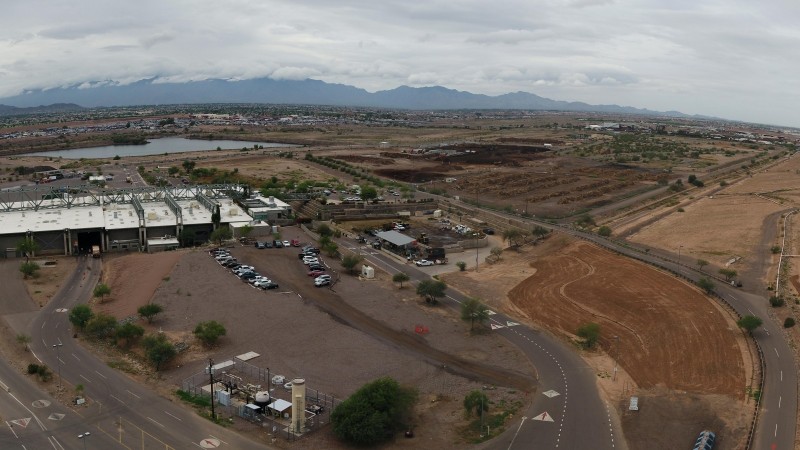
The Resource Innovation Campus (RIC) is approximately 40 acres of land allocated in a strategic area near Phoenix’s southern transfer station, material recovery facility, compost facility, and closed landfill site. The RIC is envisioned as a hub for attracting manufacturing processes, conversion technologies to transform waste into resources, and serve as a test bed for the creation of valuable public-private partnerships and growth of circular companies. Through this competition, Phoenix is looking for development of up to 20 acres using carbon-neutral, energy efficient, heat-resilient solutions that ensure sustainable water usage and meet federal air quality standards.
Learn more about the site

Download specific documents for this site
Information
Plot Area: Up to 20 acres of land south of Phoenix’s downtown area/central business district. The location is approximately 5 miles away from Phoenix City Hall.Site Ownership: City of Phoenix
